
AfriBCD Resources
Photography by Ian Farrell
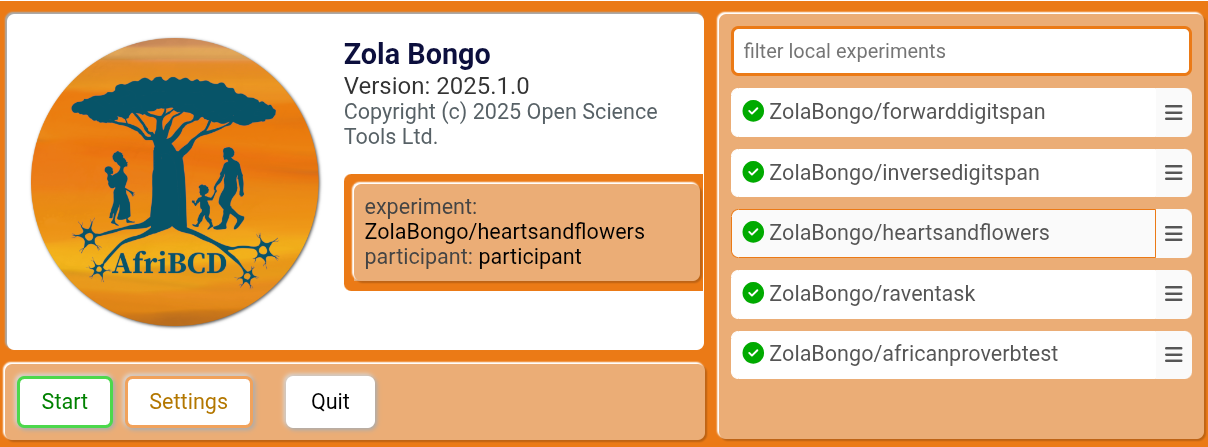
ZolaBongo App
ZolaBongo is an offline app for running PsychoPy/Pavlovia-based cognitive tasks in field and community settings. It helps research teams collect standardized task data without continuous internet access, then upload sessions when connectivity is available.
There are two versions, one with a set of short tasks voted on by AfriBCD (link to preprint), and one that is the African Neuropsychology Battery developed by Jean Ikanga (link to paper). Please cite these papers if you use either app.
A version of the app with multiple language possibilities (Swahili and French) will be coming soon, as well as a generic Psychopy version enabling users to use any set of Pavlovia compatible tasks they would like.
Don't hesitate to contact us with any questions: zolabongo@ulaval.ca
AfriBCD 2023 Snapshot Summary
This snapshot summary highlights key AfriBCD moments and accomplishments in 2023.

English:
Français:
Kiswahili:
Community of Practice Summary Report - June 2023
Taeko Bourque, Anna Blumenthal, Caylee Cook, Bosiljka Milosavljevic
This report details the goals, scope, impact, and implementation phases of the AfriBCD Community of Practice. During Phase I, we asked members of the AfriBCD network to complete a survey to create a preliminary ‘wish list’ of cognitive measures that may need more adaptation or data collection. This report also includes the survey results from 42 members and a brief summary of Phase II of the Data Collection Protocol.

Français:

AfriBCD Knowledge Exchange Meeting 2023 Summary Report
Taeko Bourque, Bosiljka Milosavljevic, Caylee Cook, Anna Blumenthal, Catherine Draper, Isabelle Blanchette, Sarah Lloyd-Fox
The first African Brain and Cognitive Development network (AfriBCD) knowledge exchange meeting brought together researchers and partners from around the world who are interested in conducting and supporting cognition research in Africa.
This report details some of the challenges and potential solutions for research in Africa, as discussed by members of our Community of Practice.
Kiswahili:

English:
Français:
How to Navigate the CoP on Teams
Based on results of the initial member survey, Teams was chosen as the best platform to grow this CoP.
Teams is further divided into Channels that are dedicated to different topics (e.g., Funding Resources, Open Science and Data Sharing, Opportunities Hub, Research Help Desk)
English :

Français:
Kiswahili:
AfriBCD CoP Reading Group
All members of the CoP are welcome to participate (on AfriBCD Teams).
As our members span the globe, our reading group operates asynchronously. Each week, we will select a paper and a new discussion thread will be created in the General Teams channel to remind everyone of the selected paper. Members may read the selected paper and respond at any time throughout the week with any comments or questions.
*Currently, the selected papers are in English.
English:

AfriBCD Code of Conduct
In order to create a supportive and inclusive environment, all members are expected to adhere to this Code of Conduct.
By participating in the CoP, you agree to abide by the following principles:
English:

Français:
Kiswahili: